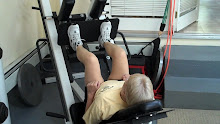
Great Leg Finisher from JC Santana.
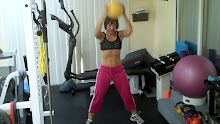
Here’s LeeAnne demonstrating the advanced version (no recovery) workout after working Legs.
2 sets
No rest between exercises
BW Squats 24 reps
Alternate Lunges 12 reps (each leg)
Alternate Split Jump 12 reps (each leg)
Squat Jumps 24 reps
Be careful if you have knee issues. Progressions start with a rest recovery.
Sunday, November 1, 2009

Friday, October 30, 2009
Balsamic Chicken Breasts
Balsamic Chicken Breasts
Nutritional Information
Calories: 130 Carbohydrate: 6g Protein: 20g Fat: 4g
Ingredients4 (4-oz) chicken breasts, skinned and boneless 2 teaspoons extra-virgin olive oil 3small cloves garlic, pressed 8 oz fresh mushrooms, quartered 3 tablespoons balsamic vinegar ½ cup low-sodium chicken broth ½ teaspoon dried thyme, crushed Freshly ground black pepper to taste 1 chopped fresh parsley for garnish
Directions
Coat a 10-inch skillet with nonstick vegetable spray. Heat over medium heat. When hot, add chicken and cook until light brown, about 3 minutes on each side. Transfer chicken to a plate. Add olive oil to pan, sauté garlic and mushrooms briefly, being careful not to burn garlic. Return chicken to pan, add vinegar, chicken broth, thyme and pepper. Reduce heat, cover and simmer for 15 minutes or until chicken is cooked. Juices will run clear when meat is pierced in its thickest part with a fork. Transfer to serving dish and top chicken with mushrooms and pan sauce. Sprinkle with chopped parsley.
Nutritional Information
Calories: 130 Carbohydrate: 6g Protein: 20g Fat: 4g
Ingredients4 (4-oz) chicken breasts, skinned and boneless 2 teaspoons extra-virgin olive oil 3small cloves garlic, pressed 8 oz fresh mushrooms, quartered 3 tablespoons balsamic vinegar ½ cup low-sodium chicken broth ½ teaspoon dried thyme, crushed Freshly ground black pepper to taste 1 chopped fresh parsley for garnish
Directions
Coat a 10-inch skillet with nonstick vegetable spray. Heat over medium heat. When hot, add chicken and cook until light brown, about 3 minutes on each side. Transfer chicken to a plate. Add olive oil to pan, sauté garlic and mushrooms briefly, being careful not to burn garlic. Return chicken to pan, add vinegar, chicken broth, thyme and pepper. Reduce heat, cover and simmer for 15 minutes or until chicken is cooked. Juices will run clear when meat is pierced in its thickest part with a fork. Transfer to serving dish and top chicken with mushrooms and pan sauce. Sprinkle with chopped parsley.
Saturday, October 10, 2009
Beneficial effects of exercise
If anyone is interested in reviewing current research here’s another one on aerobic exercise.
The study took 58 people doing just aerobics, (slow cardio) 5 days per week for 12 weeks (burning 500 calories per session). The average weight loss over the 12 weeks was 7lbs (there was a huge variance). But almost half (26 of the 58) who did participant only lost 1-2lbs over the entire 12 weeks. Again, 3 months of “aerobics only” produced limited results (not the way to go).
But on the positive side –HEALTH ---yes this type of training is “heart healthy” and is very beneficial in that regard.
This study confirms that steady state aerobic exercise is not the way to train if your goal is fat loss and body composition change, there are better methods for training (resistance training, intervals, bootcamp).
(Thanks to Craig Ballantyne for publishing this study)
**Br J Sports Med. 2009 Sep 29.Beneficial effects of exercise: shifting the focus from body weight to other markers of health.
King N, Hopkins M, Caudwell P, Stubbs J, Blundell J.
QUT, Australia;
BACKGROUND: Exercise is widely promoted as a method of weight management, whilst the other health benefits are often ignored. The purpose of this study was to examine whether exercise-induced improvements in health are influenced by changes in body weight.
METHODS: Fifty-eight sedentary overweight/obese men and women (BMI 31.8 +/-4.5kg/m2) participated in a 12 week supervised aerobic exercise intervention (70% heart rate max, 5 times a week, 500kcal per session). Body composition, anthropometric parameters, aerobic capacity, blood pressure and acute psychological response to exercise were measured at weeks 0 and 12.
RESULTS: Mean reduction in body weight was -3.3 +/-3.63kg (P<0.01). However, 26 of the 58 participants failed to attain the predicted weight loss estimated from individuals' exercise-induced energy expenditure. Their mean weight loss was only -0.9 +/-1.8kg (P<0.01). Despite attaining lower than predicted weight reduction, these individuals experienced significant increases in aerobic capacity (6.3 +/-6.0ml.kg-1.min-1; P<0.01), decreased systolic (-6.00 +/-11.5mmHg; P<0.05) and diastolic blood pressure (-3.9 +/-5.8mmHg; P<0.01), waist circumference (-3.7 +/-2.7cm; P<0.01) and resting heart rate (-4.8+/-8.9bpm, p<0.001). In addition, these individuals experienced an acute exercise-induced increase in positive mood.
CONCLUSIONS: These data demonstrate that significant and meaningful health benefits can be achieved even in the presence of lower than expected exercise-induced weight loss. Less successful reduction in body weight does not undermine the beneficial effects of aerobic exercise.
From a public health perspective, exercise should be encouraged and the emphasis on weight loss reduced.
The study took 58 people doing just aerobics, (slow cardio) 5 days per week for 12 weeks (burning 500 calories per session). The average weight loss over the 12 weeks was 7lbs (there was a huge variance). But almost half (26 of the 58) who did participant only lost 1-2lbs over the entire 12 weeks. Again, 3 months of “aerobics only” produced limited results (not the way to go).
But on the positive side –HEALTH ---yes this type of training is “heart healthy” and is very beneficial in that regard.
This study confirms that steady state aerobic exercise is not the way to train if your goal is fat loss and body composition change, there are better methods for training (resistance training, intervals, bootcamp).
(Thanks to Craig Ballantyne for publishing this study)
**Br J Sports Med. 2009 Sep 29.Beneficial effects of exercise: shifting the focus from body weight to other markers of health.
King N, Hopkins M, Caudwell P, Stubbs J, Blundell J.
QUT, Australia;
BACKGROUND: Exercise is widely promoted as a method of weight management, whilst the other health benefits are often ignored. The purpose of this study was to examine whether exercise-induced improvements in health are influenced by changes in body weight.
METHODS: Fifty-eight sedentary overweight/obese men and women (BMI 31.8 +/-4.5kg/m2) participated in a 12 week supervised aerobic exercise intervention (70% heart rate max, 5 times a week, 500kcal per session). Body composition, anthropometric parameters, aerobic capacity, blood pressure and acute psychological response to exercise were measured at weeks 0 and 12.
RESULTS: Mean reduction in body weight was -3.3 +/-3.63kg (P<0.01). However, 26 of the 58 participants failed to attain the predicted weight loss estimated from individuals' exercise-induced energy expenditure. Their mean weight loss was only -0.9 +/-1.8kg (P<0.01). Despite attaining lower than predicted weight reduction, these individuals experienced significant increases in aerobic capacity (6.3 +/-6.0ml.kg-1.min-1; P<0.01), decreased systolic (-6.00 +/-11.5mmHg; P<0.05) and diastolic blood pressure (-3.9 +/-5.8mmHg; P<0.01), waist circumference (-3.7 +/-2.7cm; P<0.01) and resting heart rate (-4.8+/-8.9bpm, p<0.001). In addition, these individuals experienced an acute exercise-induced increase in positive mood.
CONCLUSIONS: These data demonstrate that significant and meaningful health benefits can be achieved even in the presence of lower than expected exercise-induced weight loss. Less successful reduction in body weight does not undermine the beneficial effects of aerobic exercise.
From a public health perspective, exercise should be encouraged and the emphasis on weight loss reduced.
Sunday, September 27, 2009
Should YOU run?
Last week I sent out Mike Boyle’s article on “Why (Most) Women Shouldn’t Run” knowing it would elicit some strong opinions, and yes it did. But again not everyone is going to agree and I for one would never discourage someone from exercising. So if running is a big part of your fitness plan then keep moving and enjoy your runs.
Reasons why running could be a negative:
1) Injuries
For me personally and as a Personal Trainer I would never include DISTANCE running as part of a beginner’s program or a fat loss program for anyone, female or male. I look out my window everyday and see runners go up and down my street day and night. One thing in common, their bodies NEVER change and we’re talking years of training and logging many miles. Doesn't that tell you something? For most of us long distance running doesn’t change your body. I watch some of these people running and it just looks painful. It’s more of a speed limp not a smooth athletic run. How can they possibly think that this is good for them? In all my years of working with clients I have never meet a person over 30 years old that runs consistently that hasn’t suffered an injury from running. So please understand what you’re getting yourself into if you decide to take up running and please take precautions. My issue with distance running is the constant pounding your body takes. Within any given mile, there are about 1500 foot strikes. Think about that. You better have a great pair of running shoes and great running form
2) Need variety in your training
The fact of the matter is, most (read: not all) people shouldn't’t be running (especially women). What’s the first thing that women do to get into shape? They’re off to Sport’s Authority buying the latest running shoes and go jogging the next day. What’s the first piece of equipment that women will gravitate towards if they have never set foot in a gym before? The treadmill. Once in the gym and after they get comfortable they stick with that piece of equipment and end up making running the biggest part of their fitness plan. If your plan includes just running than your body will eventually stop responding. This type of exercise is considered steady-state cardio. Your body adapts extremely fast to steady-state cardio and you'll burn fewer and fewer calories the more you do.
Most of the clients that come to me are looking to change their bodies and get in shape. Many of these are average people who aren't active, and certainly aren't runners. But they want to look fit and in shape. With this type of clientele, I'd never start them off with a long jog which would be equivalent to 1,500 reps of a one-legged polymeric exercise. That would be irresponsible on my part and my client would most likely suffer some sort of lower-body injury. Not what we want.
Who should run?
1) Folks training for an endurance event.
2) If your sport requires running and you want to train for that sport.
3) If it’s the only type of exercise you enjoy.
4) If you love the outdoors and look forward to that “runners high” –I’m not going to discourage you.
5) If your running is interval training –hills, walk/run or sprint.
6) Yes aerobic type training is heart healthy
Sprinting is NOT the running I’m talking about.
Now some people might say that they see me running at the track. Why is it ok for me……? Yes that’s true. I love sprints, 50-70 yards. Believe it or not running sprints is actually safer than distance running over time. Keep in mind, you have to prepare your body to sprint. And sprinting is advanced work and you have to build up to it and prepare your body before and all out effort sprint. It’s critical if you decide to start a sprinting program that you stretch, foam roll and resistance train before embarking on this type of training. Now we’re not sprinting everyday, 1 -3 times a week will burn body fat and improve your conditioning level beyond belief. The drawback, sprints are tough, intervals are hell. Most people that run for distance want nothing to do with this type of workout program. Too bad for them I think they’re missing out on a superior workout.
Please keep in mind, that I am NOT saying that running is “bad” for everyone, nor am I saying that it is “bad” in general. But what I am saying is that there are better ways to get into shape and drop body fat. And that’s the point…you need to be in shape to run. In doing so, your body will be able to handle the stress MUCH more efficiently and you will be less prone to all of those nagging injuries that come with being a distance runner.
Confused? Hope not. If you’re looking to start an exercise program, let’s talk. Let’s make sure you’re taking the safest and best route. If running is part of your routine, please make sure you understand that it’s an advanced exercise and it isn't for beginners or out of shape people trying to get fit. For those individuals, there are better choices.
And keep in mind your goals, if it’s losing weight, getting leaner and changing your body’s shape running doesn't have to be a part of your routine. On the other hand, if you have a goal of completing an endurance event or just enjoy running, you'll need to make sure your program includes injury prevention strength exercises. Make sure your fitness program includes some bodyweight exercises, functional work to correct any potential muscle imbalances, single-leg movements, and core/abs strengthening. The last thing you want is to be sitting on the sidelines recovering from an injury.
Train safe and Train smart!
Reasons why running could be a negative:
1) Injuries
For me personally and as a Personal Trainer I would never include DISTANCE running as part of a beginner’s program or a fat loss program for anyone, female or male. I look out my window everyday and see runners go up and down my street day and night. One thing in common, their bodies NEVER change and we’re talking years of training and logging many miles. Doesn't that tell you something? For most of us long distance running doesn’t change your body. I watch some of these people running and it just looks painful. It’s more of a speed limp not a smooth athletic run. How can they possibly think that this is good for them? In all my years of working with clients I have never meet a person over 30 years old that runs consistently that hasn’t suffered an injury from running. So please understand what you’re getting yourself into if you decide to take up running and please take precautions. My issue with distance running is the constant pounding your body takes. Within any given mile, there are about 1500 foot strikes. Think about that. You better have a great pair of running shoes and great running form
2) Need variety in your training
The fact of the matter is, most (read: not all) people shouldn't’t be running (especially women). What’s the first thing that women do to get into shape? They’re off to Sport’s Authority buying the latest running shoes and go jogging the next day. What’s the first piece of equipment that women will gravitate towards if they have never set foot in a gym before? The treadmill. Once in the gym and after they get comfortable they stick with that piece of equipment and end up making running the biggest part of their fitness plan. If your plan includes just running than your body will eventually stop responding. This type of exercise is considered steady-state cardio. Your body adapts extremely fast to steady-state cardio and you'll burn fewer and fewer calories the more you do.
Most of the clients that come to me are looking to change their bodies and get in shape. Many of these are average people who aren't active, and certainly aren't runners. But they want to look fit and in shape. With this type of clientele, I'd never start them off with a long jog which would be equivalent to 1,500 reps of a one-legged polymeric exercise. That would be irresponsible on my part and my client would most likely suffer some sort of lower-body injury. Not what we want.
Who should run?
1) Folks training for an endurance event.
2) If your sport requires running and you want to train for that sport.
3) If it’s the only type of exercise you enjoy.
4) If you love the outdoors and look forward to that “runners high” –I’m not going to discourage you.
5) If your running is interval training –hills, walk/run or sprint.
6) Yes aerobic type training is heart healthy
Sprinting is NOT the running I’m talking about.
Now some people might say that they see me running at the track. Why is it ok for me……? Yes that’s true. I love sprints, 50-70 yards. Believe it or not running sprints is actually safer than distance running over time. Keep in mind, you have to prepare your body to sprint. And sprinting is advanced work and you have to build up to it and prepare your body before and all out effort sprint. It’s critical if you decide to start a sprinting program that you stretch, foam roll and resistance train before embarking on this type of training. Now we’re not sprinting everyday, 1 -3 times a week will burn body fat and improve your conditioning level beyond belief. The drawback, sprints are tough, intervals are hell. Most people that run for distance want nothing to do with this type of workout program. Too bad for them I think they’re missing out on a superior workout.
Please keep in mind, that I am NOT saying that running is “bad” for everyone, nor am I saying that it is “bad” in general. But what I am saying is that there are better ways to get into shape and drop body fat. And that’s the point…you need to be in shape to run. In doing so, your body will be able to handle the stress MUCH more efficiently and you will be less prone to all of those nagging injuries that come with being a distance runner.
Confused? Hope not. If you’re looking to start an exercise program, let’s talk. Let’s make sure you’re taking the safest and best route. If running is part of your routine, please make sure you understand that it’s an advanced exercise and it isn't for beginners or out of shape people trying to get fit. For those individuals, there are better choices.
And keep in mind your goals, if it’s losing weight, getting leaner and changing your body’s shape running doesn't have to be a part of your routine. On the other hand, if you have a goal of completing an endurance event or just enjoy running, you'll need to make sure your program includes injury prevention strength exercises. Make sure your fitness program includes some bodyweight exercises, functional work to correct any potential muscle imbalances, single-leg movements, and core/abs strengthening. The last thing you want is to be sitting on the sidelines recovering from an injury.
Train safe and Train smart!
Sunday, September 20, 2009
Why (Most) Women Shouldn't Run
This might be good timing, this article has been around for a while and when it originally came out it stirred up allot of controversy. As you know, I'm not a huge fan of running for fat loss or for beginners. But last week I talked to a client that used to work out at the gym I worked at. After a short "catching up" conversation she informed me she was "trying to get back into shape" and "trying to lose a few pounds" by starting a running program. Not what I wanted to hear, but I understand that type of mentality is still out there. Again there are many other ways to successful weight loss without injuring yourself -sorry running isn't one of them. I will expand on this in a future article, but for now please read Mike's article and tell me what you think...........
By Michael Boyle
I really like Diane Lee's quote, "You can't run to get fit, you need to be fit to run." In fact, I've used it in numerous presentations and articles. It really resonates with me. Simple, to the point. I'm going to take the idea one step further. I'm not sure most women should run. When I say this in seminars, it really pisses off the female runners. Sorry, I'm not worried about you; I'm worried about all the other women. If you are a runner and healthy, read on, but realize that you are the exception, not the rule. I'm going to go from bad to worse. Here's a riddle for you. Q- What do most female runners look like?A- Male runners.Ever ask yourself why? I'm going to let you in on a little secret. Women who run successfully for long periods of time were made to run. They look just like men runners. Good female runners generally do not look like plus-size models. It's not a question of cause and effect; it's a question of natural selection. You can't run to get that cute little runner's body. It's actually reversed. You have to have that cute little runner's body to survive running. Why do I say this? Two simple reasons. Anatomy and physics. My favorite two sciences. No matter how hard you try or how well you eat, you can't change your skeleton. The problem with most women and running comes down to something they call Q angle in sportsmedicine. I won't bore you with the details, but it boils down to this. Wider hips make for narrow knees. This angle of hip to knee creates problems. Problems are magnified based on the number of steps. The average person gets about 1500 foot strikes per mile. Do the math on your 5-mile run. Running produces forces in the area of two to five times bodyweight per foot contact. Do we need more math? Let's go back to our elite female runner. Look at her body. You will generally see two things. She has narrow hips and she has small breasts. I know, there may be exceptions, but at the elite level, I doubt it. One thought process would say, Great, my hips and breasts will decrease in size if I run. The other thought process is more logical. Women with larger breasts and wider hips don't make good runners. It is the same logic as why there are no large gymnasts or figure skaters. Physics. Big people rotate slower. Natural selection rules it out. So what happens when a "normal" woman begins to run? She becomes a statistic. She becomes a physical-therapy client as she tries to shovel you-know-what against the tide. Her wider knees cause her to develop foot problems or most likely knee problems. Her greater body weight causes greater ground reaction forces. Greater ground reaction forces stress muscle tissue and breast tissue. Get my drift yet? The end result is likely to be hurt and saggy instead of the cute and little. The bottom line: Running is not good for most females. If you want higher-intensity exercise, ride a stationary bike. Take a spin class, use a stairclimber, and don't run.
PS- The best stuff is the hard stuff. Use the AirDyne Bike or the StepMill. Don't take the easy way out.
By Michael Boyle Reproduced with permission
By Michael Boyle
I really like Diane Lee's quote, "You can't run to get fit, you need to be fit to run." In fact, I've used it in numerous presentations and articles. It really resonates with me. Simple, to the point. I'm going to take the idea one step further. I'm not sure most women should run. When I say this in seminars, it really pisses off the female runners. Sorry, I'm not worried about you; I'm worried about all the other women. If you are a runner and healthy, read on, but realize that you are the exception, not the rule. I'm going to go from bad to worse. Here's a riddle for you. Q- What do most female runners look like?A- Male runners.Ever ask yourself why? I'm going to let you in on a little secret. Women who run successfully for long periods of time were made to run. They look just like men runners. Good female runners generally do not look like plus-size models. It's not a question of cause and effect; it's a question of natural selection. You can't run to get that cute little runner's body. It's actually reversed. You have to have that cute little runner's body to survive running. Why do I say this? Two simple reasons. Anatomy and physics. My favorite two sciences. No matter how hard you try or how well you eat, you can't change your skeleton. The problem with most women and running comes down to something they call Q angle in sportsmedicine. I won't bore you with the details, but it boils down to this. Wider hips make for narrow knees. This angle of hip to knee creates problems. Problems are magnified based on the number of steps. The average person gets about 1500 foot strikes per mile. Do the math on your 5-mile run. Running produces forces in the area of two to five times bodyweight per foot contact. Do we need more math? Let's go back to our elite female runner. Look at her body. You will generally see two things. She has narrow hips and she has small breasts. I know, there may be exceptions, but at the elite level, I doubt it. One thought process would say, Great, my hips and breasts will decrease in size if I run. The other thought process is more logical. Women with larger breasts and wider hips don't make good runners. It is the same logic as why there are no large gymnasts or figure skaters. Physics. Big people rotate slower. Natural selection rules it out. So what happens when a "normal" woman begins to run? She becomes a statistic. She becomes a physical-therapy client as she tries to shovel you-know-what against the tide. Her wider knees cause her to develop foot problems or most likely knee problems. Her greater body weight causes greater ground reaction forces. Greater ground reaction forces stress muscle tissue and breast tissue. Get my drift yet? The end result is likely to be hurt and saggy instead of the cute and little. The bottom line: Running is not good for most females. If you want higher-intensity exercise, ride a stationary bike. Take a spin class, use a stairclimber, and don't run.
PS- The best stuff is the hard stuff. Use the AirDyne Bike or the StepMill. Don't take the easy way out.
By Michael Boyle Reproduced with permission
Sunday, September 13, 2009
Conditioning work
In addition to resistance exercise, you should also include some conditioning exercise, often called cardio. Don’t confuse steady state aerobics like long jogs, bike rides, or the Elliptical as your conditioning work, this type of exercise is not all that effective for fat loss or true conditioning.
If you're healthy and in fairly good shape try high intensity interval exercise, in which you work really hard for 20-90 seconds, rest, work hard again, rest again. This type of cardio work has been shown to be the most effective form of conditioning work and for burning body fat.
Here’s LeeAnne demonstrating one of my favorite forms of conditioning exercise: interval circuits.
Today is 40s work and 20s rest –repeat total Circuit 2-4 times –rest 2min between Circuit.
And believe it or not, this workout is way more effective at burning fat and improving her conditioning than 45-60 minutes of walking or jogging!
Circuit 1
1) Valside Rev Lunge with row (one-side)
2) Valside Rev Lunge with row (other side)
3) Split Jump
4) Bosu pushup
5) Core Plank with disk
6) MB thrust with press
7) Wide Narrow BW Squat
Circuit 2
1) Step Reach Lunge with MB push
2) Jumping Jack with rear delt
3) T Rotation
4) Smash non-bounce MB
5) Bar situp w/leg raise
6) 5 dot drill
7) MB Step jump
If you're healthy and in fairly good shape try high intensity interval exercise, in which you work really hard for 20-90 seconds, rest, work hard again, rest again. This type of cardio work has been shown to be the most effective form of conditioning work and for burning body fat.
Here’s LeeAnne demonstrating one of my favorite forms of conditioning exercise: interval circuits.
Today is 40s work and 20s rest –repeat total Circuit 2-4 times –rest 2min between Circuit.
And believe it or not, this workout is way more effective at burning fat and improving her conditioning than 45-60 minutes of walking or jogging!
Circuit 1
1) Valside Rev Lunge with row (one-side)
2) Valside Rev Lunge with row (other side)
3) Split Jump
4) Bosu pushup
5) Core Plank with disk
6) MB thrust with press
7) Wide Narrow BW Squat
Circuit 2
1) Step Reach Lunge with MB push
2) Jumping Jack with rear delt
3) T Rotation
4) Smash non-bounce MB
5) Bar situp w/leg raise
6) 5 dot drill
7) MB Step jump
Saturday, September 5, 2009
A little Met workout
LeeAnne will demonstrate
40seconds work
15 sec rest
each circuit 2-3 sets
rest 1 -2 min between circuits
Circuit 1
DB Squat & Press
½ Jacks –(try not to collapse your knees!)
BB Bent over Row
Skaters
SB Bridges
Hill Run 15.0 incline 4.5 speed
Bosu pushup
Circuit 2
DB Reach Lunge & Press
DB Step-ups
SB Press
Bosu Lateral Shuffle
Valslide 1-arm Push Away
Hill Run 15.0 incline 4.5 speed
Valslide Reverse Lunge w/Lateral Raise & Front Raise
40seconds work
15 sec rest
each circuit 2-3 sets
rest 1 -2 min between circuits
Circuit 1
DB Squat & Press
½ Jacks –(try not to collapse your knees!)
BB Bent over Row
Skaters
SB Bridges
Hill Run 15.0 incline 4.5 speed
Bosu pushup
Circuit 2
DB Reach Lunge & Press
DB Step-ups
SB Press
Bosu Lateral Shuffle
Valslide 1-arm Push Away
Hill Run 15.0 incline 4.5 speed
Valslide Reverse Lunge w/Lateral Raise & Front Raise
Subscribe to:
Posts (Atom)



.jpg)